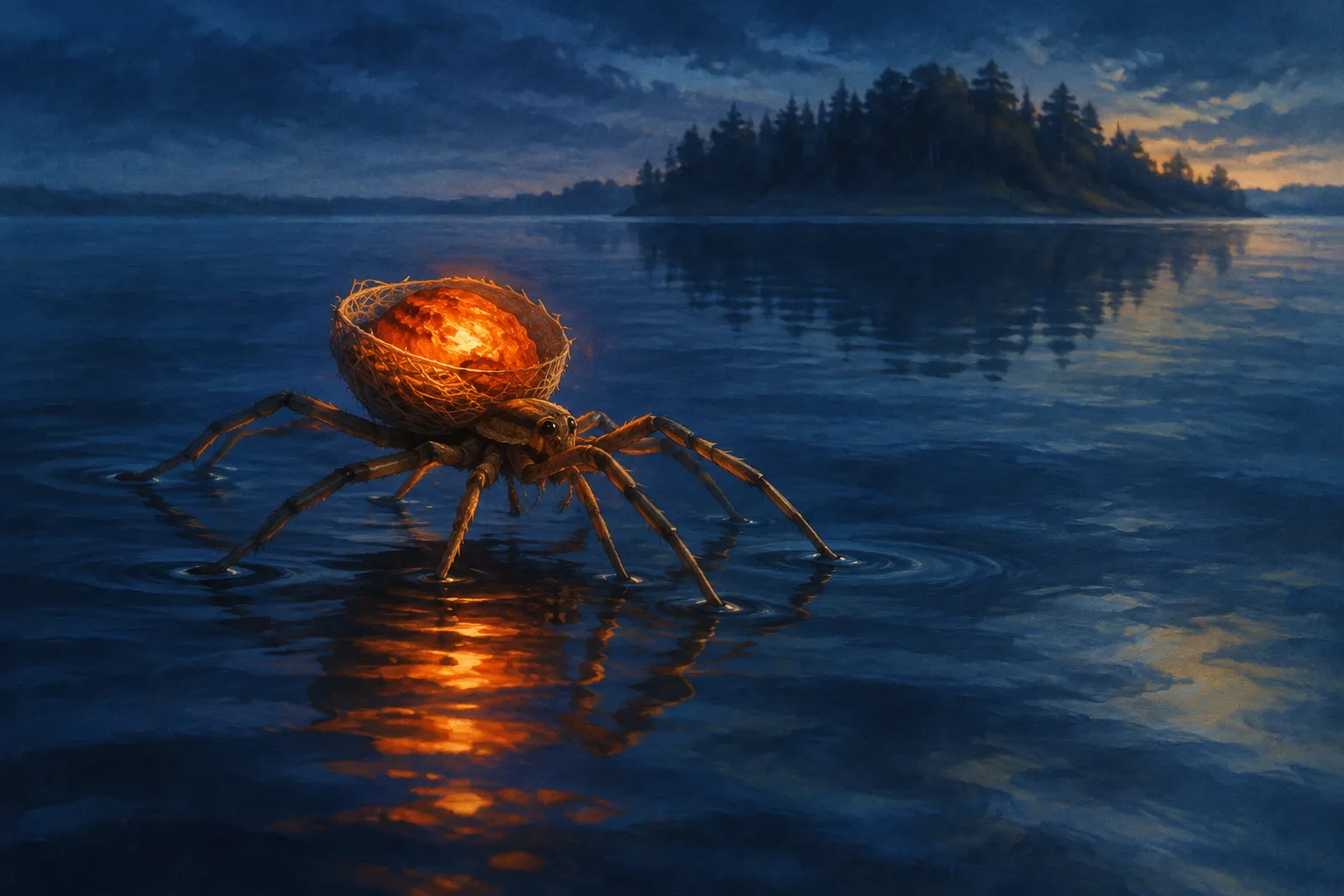
The animals can reach the fire. What they cannot do is bring it back. That distinction gives a Cherokee First Fire story its wonderfully precise turning point: Water Spider does not need to overpower the flames. She needs a way to carry something small and dangerous across the water.
In Pamela Tambornino’s published account of her grandmother’s telling, a bowl woven from web makes the difference. Read closely, the episode offers more than a victory for an unlikely helper. It asks what counts as ability when everyone faces the same problem but possesses different gifts.
A family telling, not a universal script
The textual starting point here is a specific public account, published on May 15, 2010, in Tribal College Journal. Its author, Pamela Tambornino, identifies as Cherokee, Wolf Clan, and recalls learning the story from her grandmother Maggie. Her memories include time together in Pawhuska, Oklahoma. Those details establish a family setting for the telling rather than an anonymous, supposedly universal Indigenous legend. Tambornino’s personal introduction is therefore part of the evidence, not merely a preface to discard.
This article follows that published narrative and offers a close reading of its central problem. It does not claim to reconstruct the earliest form of the story or speak for every Cherokee storyteller. Where a contemporary artist’s interpretation enters the discussion, it is identified separately.
That distinction matters because an interpretation can be illuminating without becoming a rule. Saying that the web bowl rewards practical imagination is a reading of this telling. Saying that all Cherokee people understand every detail in exactly that way would go beyond the evidence.
The journey that flight cannot finish
In the grandmother’s narrative, Thunder has lightning place fire inside a hollow tree. Water separates the animal people from the island. Raven flies over but returns scorched black. The owls encounter fire and smoke, which leave marks on their eyes; Snake also returns blackened. Water Spider proposes carrying fire in a web bowl on her back. She crosses, collects a small piece, and returns successfully.
Consider how the problem changes as the attempts unfold. At first, the water seems to be the obvious obstacle. Flight appears promising because it can bypass that barrier. Yet arriving at the tree is not the same as completing the task. The successful journey must include a return trip with fire still in the traveler’s possession.
Read this way, the earlier attempts are not pointless interruptions before the real hero arrives. They reveal what an adequate solution must accomplish. Access alone is insufficient. A useful plan must account for the dangerous thing being transported.
The physical changes to the unsuccessful travelers also interrupt any easy division between success and insignificance. Their attempts leave lasting consequences within the story. They do not bring back fire, but neither do they simply disappear from the narrative once Water Spider volunteers.
Why the bowl changes the question
The decisive question in Tambornino’s telling concerns how Water Spider will carry the fire. Her answer is not a claim to greater strength. It is a container.
That detail invites a practical reading of the story’s structure. Rather than attempting to become a better version of Raven or Snake, Water Spider approaches the difficulty through her own capacity. The solution fits the helper. Her success does not require everyone to have identical abilities.
The bowl also makes scale important. To complete the journey, she need not move the burning tree. A small portion of fire is enough. The contrast between the threatening source and the manageable burden helps explain why a seemingly modest object occupies the center of the episode.
This is interpretation, not a technical explanation of how spider silk behaves around heat. The narrative does not need to function as a natural-history demonstration to make its problem intelligible. Its imagined bowl gives the audience something concrete to picture: a dangerous gift made portable.
There is also a useful difference between cleverness directed toward others and cleverness directed toward a shared difficulty. Readers of this site’s discussion of Possum outsmarting the wolves in a Choctaw story can approach this as a different narrative question: here, the focus is not an opponent to deceive, but a task to finish. The traditions remain distinct; the reading question is what ingenuity accomplishes.
A contemporary Cherokee artist makes smallness visible
A separate, contemporary interpretation appears in Cherokee Nation citizen Karen Sixkiller’s account of her sculpture, Grandma Spider/First Fire. Her page documents its installation in May 2024 on the Cultural Pathway in Tahlequah, Oklahoma, between the Cherokee Arts Center and Spider Gallery.
Sixkiller’s steel-and-bronze work gives the small helper a monumental presence. A red crystal sphere in a bronze pot represents the fire on the spider’s back. Her explanation explicitly connects the project with empowerment and inclusion: people regarded as small or weak may possess the ability a community needs. That is the artist’s stated interpretation, not an inference imposed on her work. Her description of the project makes the connection clear.
The sculpture should not be treated as an illustration of every detail in Tambornino’s text. One presents a woven web bowl; the other uses a bronze pot and crystal to communicate through metal sculpture. Keeping those forms separate allows each maker’s choices to remain visible.
The change in scale is especially suggestive. A reader encounters a tiny traveler carrying a small burden; a visitor encounters an enlarged figure that demands attention. The sculpture can be read as reversing the tendency to overlook the helper whose contribution proved decisive.
A story carried forward, not closed away
Another public point of contact is OsiyoTV’s 2022 segment A Fire for the Future: Cherokee Storyteller Whitney Roach. Its HTML introduction identifies Roach as a Cherokee storyteller and former Miss Cherokee, and describes Water Spider’s bringing of first fire as her favorite Cherokee story. That description documents another public presentation; it does not provide a transcript from which to reconstruct her wording.
Together, these sources offer different kinds of access: a family account committed to print, an artist’s explanation of a public sculpture, and a program introducing a storyteller. They should not be flattened into one composite version. Their value lies partly in showing identifiable people choosing how to share and interpret the story.
For the reader of Tambornino’s telling, the bowl remains the detail worth holding onto. It changes the challenge from reaching something powerful to bringing back something useful. Water Spider succeeds not by erasing her difference from the other animals, but through a solution that makes that difference matter.
Sources and further reading
- Pamela Tambornino, My Cherokee Grandmother’s “First Fire Story”, Tribal College Journal, May 15, 2010. The family telling examined here.
- Karen Sixkiller, Grandma Spider/First Fire. The artist’s account of her sculpture and its interpretation.
- OsiyoTV, A Fire for the Future: Cherokee Storyteller Whitney Roach, 2022. A public introduction to a contemporary storyteller’s presentation.


