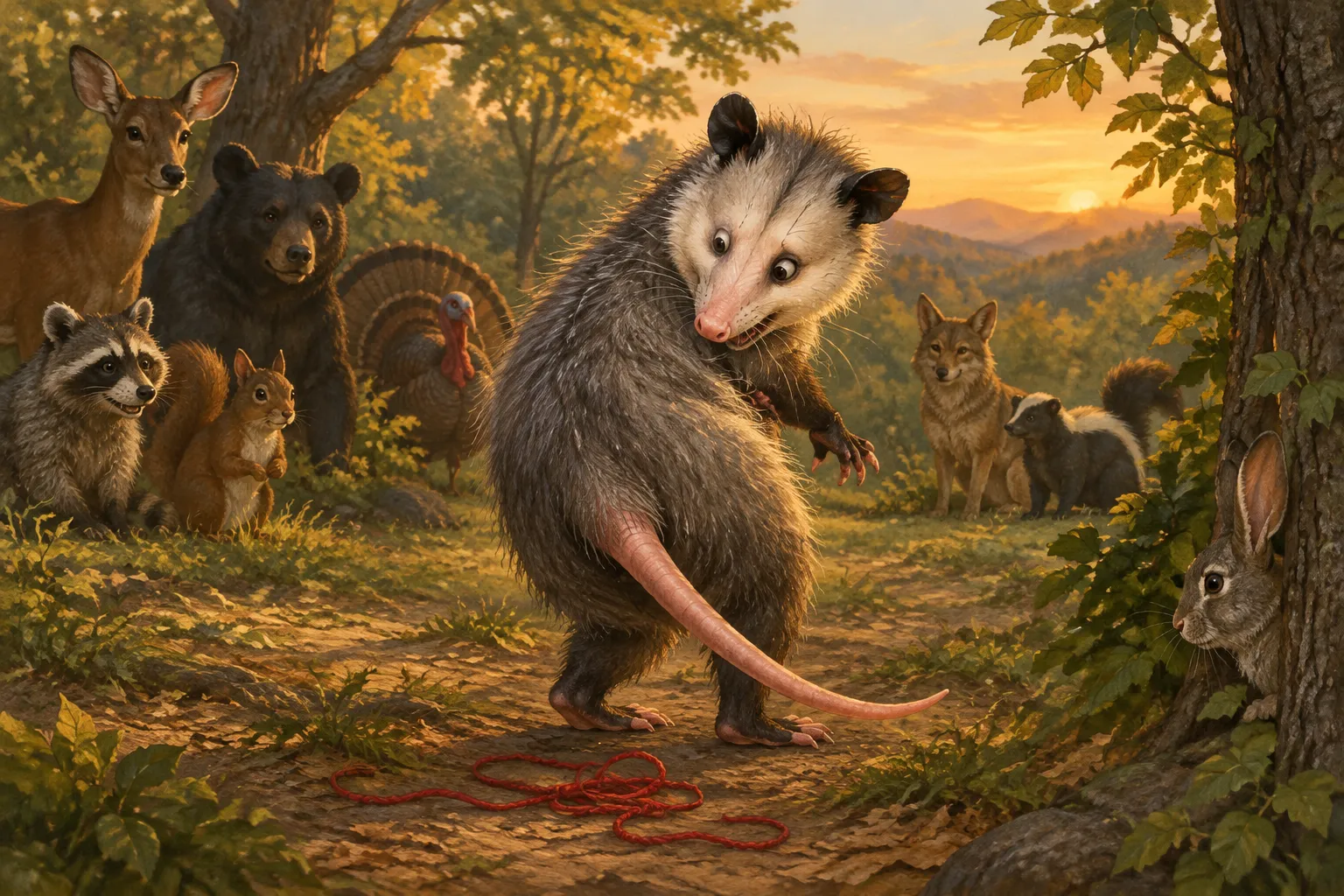
Possum gets exactly what he asks for: the best seat at the gathering, a carefully prepared tail, and an audience ready to notice him. What he does not get is the admiration he expects. In the Cherokee story reproduced from James Mooney’s Myths of the Cherokee, Rabbit turns Possum’s confidence into the means of his humiliation. Cricket supplies the practical skill, and Possum supplies the finishing touch by performing before he looks behind him. The result explains both his bare tail and his helpless reaction when surprised. Mooney’s published telling makes the reveal depend on a particularly sharp joke: Possum mistakes laughter for applause.
A Cherokee story with identifiable tellings
This article follows the text attributed to Mooney on the Native History Association’s website. It also considers a distinct telling by Freeman Owle, publicly shared in an educational packet from the Museum of the Cherokee Indian. These are identifiable textual witnesses, not interchangeable pieces of one supposedly definitive story. The association’s page names Mooney as its source but does not identify the individual Cherokee narrator behind this particular account. That limit matters: the printed wording should not be presented as the voice of every Cherokee storyteller. The reproduction’s source attribution establishes what text we are reading, not a universal version.
Owle’s telling appears in Barbara R. Duncan’s Living Stories of the Cherokee, published in 1998. The University of North Carolina Press description identifies its contributors as six storytellers from the Eastern Band of Cherokee Indians in North Carolina who learned through family and community. Its seventy-two traditional and contemporary stories place animal tales within an ongoing storytelling practice, rather than a vanished world. That community setting is especially important when comparing a named storyteller’s performance with an older collected text.
The invitation that makes the trap possible
In the Mooney text, Possum begins with a long, bushy tail. He combs it daily and celebrates it in song at dances. Rabbit, whose own tail has been pulled out by Bear, becomes jealous. The story therefore gives the trickster a motive beyond correcting bad behavior. Possum is vain, but Rabbit is envious; neither enters the encounter as an uncomplicated moral example. Those two desires meet when Rabbit undertakes his responsibility to spread news of an animal council and dance. The opening of the story establishes both the rivalry and Rabbit’s opportunity.
Possum makes his attendance conditional on receiving a prominent seat. His handsome tail, he thinks, deserves public visibility. Rabbit agrees and adds an apparently generous offer: someone will come to groom the tail before the dance. Read closely, the invitation is a trap constructed from things Possum already wants. Rabbit does not threaten him or lure him with an unfamiliar ambition. He simply promises a more complete version of the attention Possum seeks.
This is one reason the episode works as comedy rather than merely as a sudden punishment. Possum actively helps arrange the circumstances of the reveal. He wants an audience, accepts special treatment, and trusts an offer that flatters him. That reading follows the sequence of Rabbit’s promises and Possum’s agreement; it is an interpretation of the plot, not a claim about a single Cherokee moral doctrine.
Cricket hides the damage in plain sight
Rabbit recruits Cricket, described in the text as an expert haircutter. Cricket’s skill makes the trick possible. The next morning, Possum lies down and closes his eyes while his visitor works. Cricket winds red string around the tail, supposedly to keep its hair smooth until the evening. While wrapping, however, he clips the hair close to its roots. Preparation and destruction happen together, with the wrapping concealing what the grooming has actually accomplished. Cricket’s visit is the quiet center of the deception.
The string is not an incidental decoration. It creates a delay between the loss of the hair and Possum’s discovery of that loss. Without the wrapping, he could see the result before leaving home. With it, he carries the evidence into the gathering himself. The story turns an ordinary assurance—that careful preparation will preserve a beautiful appearance—into the mechanism that prevents him from checking the truth.
Rabbit even keeps his promise about the seat. When Possum arrives at the townhouse for the dance, the best place is waiting. This fulfilled promise helps sustain the larger falsehood. As an interpretation, the detail makes Rabbit’s deception more pointed: not everything he offers is untrue. Enough of the arrangement is genuine to carry Possum toward the moment when he will expose himself. The arrival at the townhouse confirms that the promised honor is part of the trap.
When laughter sounds like praise
Possum loosens the string and enters the dance. As the drummers play, he sings successive praises of his tail: its appearance, its color, the way it sweeps the ground, and its fur. The animals respond more loudly, and he takes their response as encouragement. Only after their laughter continues does he look down and discover that the hair is gone. Astonishment and shame leave him speechless; he rolls helplessly on the ground and grins. The narrator connects this ending with Possum’s behavior when taken by surprise. The dance and its aftermath bring the physical explanation and the social embarrassment together.
The strongest joke is the gap between what Possum believes and what everyone else can see. His song becomes less accurate with every boast, but he interprets the growing noise as proof that he is succeeding. On this reading, vanity is not simply liking a beautiful tail. It is allowing the desire for approval to replace attention to what is happening.
Rabbit’s cleverness is also less secure than it might first appear. He succeeds here by manipulating another animal’s expectations. Readers who know the Cherokee story of Terrapin beating Rabbit across four ridges have a useful companion reading: Rabbit need not occupy the winning position in every encounter. The comparison invites attention to each story’s particular arrangement of confidence and deception, rather than treating cleverness as a permanent guarantee of victory.
What Freeman Owle’s version changes
In Freeman Owle’s telling shared by the museum, Possum first admires his reflection in still water. His repeated boasting wears out the other animals. Fox and Cricket arrange a beautiful-tail contest; Cricket chews off the hair, and the tail is wrapped in deerskin. The public unveiling leads to anger and then playing dead. Owle explicitly frames the story as a teaching against boasting. These differences should remain visible, not be blended into Mooney’s plot.
Changing the instigator changes the emphasis. Rabbit’s jealousy drives the older printed account, whereas collective irritation is prominent in Owle’s telling. That contrast is a reading of the two accessible texts, not evidence that one replaces or corrects the other. Their shared comic situation allows different motives and teaching emphases to emerge. Mooney’s opening and the museum’s Owle excerpt support that distinction.
The publisher describes Duncan’s collection as preserving the rhythmic quality of spoken storytelling through an oral-poetics format. That is a reminder to read for pacing as well as plot. A wrapped tail, an expectant audience, and a delayed glance make a memorable sequence—but the named teller’s arrangement gives that sequence its particular force. The collection’s account of its presentation encourages readers to hear stories as performances, not merely extract their lessons. Possum’s mistake is easy to recognize; attending to who tells it keeps the recognition grounded in Cherokee voices and texts.
Sources and further reading
- Why the Possum’s Tail Is Bare — Native History Association’s reproduction of the James Mooney text; the principal narrative examined here.
- Museum of the Cherokee Indian information packet — includes Freeman Owle’s telling from Living Stories of the Cherokee and educational guidance.
- Living Stories of the Cherokee — University of North Carolina Press’s description of the 1998 collection, its Eastern Band storytellers, and its oral-poetics presentation.


